6.7 Portuguese Colonial Enterprise
Establishment of Portuguese Control in Indian Seas and Its Economic and Political Impact
- Vasco da Gama 1498 landed at Calicut guided by Abdul Majid.
- A direct sea link would displace monopoly of Arabs and Turks over trade in eastern goods esp spices.
- Along with commercial there were Religious reasons too since Muslims were traditional enemies of Christianity.
- @ Henry the Navigator sent 2-3 ships every year for exploration. Genoese merchants used to buy goods from Arabs and sold it in Europe but after capture of Constantinople by Turks their trade stopped so they further fuelled exploration of a route to India.
- Renaissance created a spirit of daring
- Economic growth led to dietary changes.
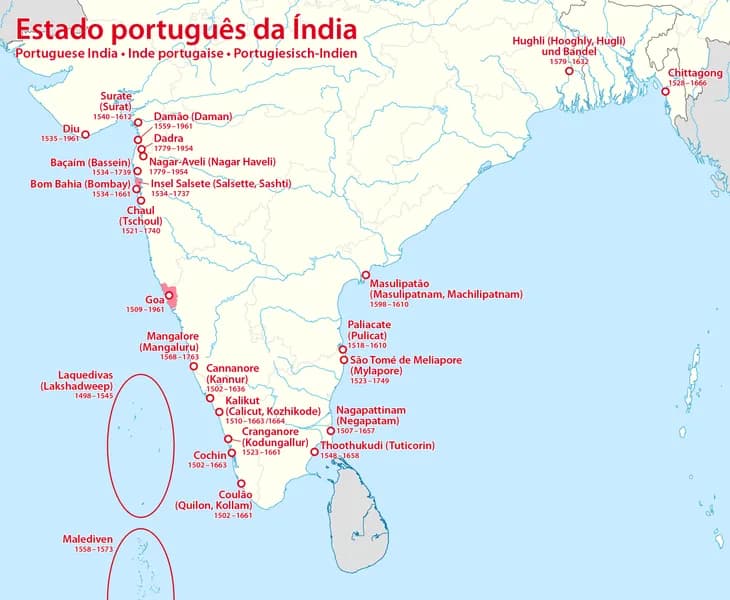
Portugues Estado Da India
- wanted to enforce monopoly of spice trade to Europe and demanded the right to search ships of Arab traders -> fight where Portuguese killed.
- Da Gama returned w/ 25 vessels and demanded Zamorin expel the Muslim merchants. Zamorin rejected and was assaulted.
- P estd forts at Cochin, Quilon etc.
Embedded from 1.1 Early European Settlements, The Portugues and the Dutch › Portuguese
- Vasco da Gama came in 1498, trading factory at Cannanore, Cochin and Calicut - imp trading centres
- voyage undertaken by Pedro Alvarez Cabral to trade for spices, establishing factory at Calicut arrived in September 1500
Francisco De Almeida
- appointed in 1505 to consolidate position
- destroy Muslim trade - seized Aden, Ormuz and Malacca.
- advised to build fortresses at Anjadiva, Cochin, Cannanore and Kilwa.
- Blue Water Policy aka Cartaze System started by him
- Sultan of Egypt, Ruler of Gujarat and Zamorin of Calicut sent fleet to defeat Portuguese but were routed in 1509 making their navy supreme in the area.
Afonso De Albuquerque
- from 1509
- estd bases in East Africa, off the Red Sea, at Ormuz; in Malabar; and at Malacca later in Sri Lanka, Sumatra, Malacca.
- permit system for other ships
- control over major ship-building centres
- acquired Goa from Sultan of Bijapur in 1510. Goa was excellent natural harbour and fort, strategically located to control Malabar trade and close to Gujarat.
- Abolished sati, encouraged to take local wives
- new roads and irrigation works,
- new crops eg tobacco and cashew nut, or better plantation varieties of coconut
Nino Da Cunha
- appointed November 1529
- shifted headquarters of from Cochin to Goa.
- Bahadur Shah of Gujrat took help from him against Humayun, drowned in 1537
Administraton
- head Viceroy serv 3 years, w/ secretary in later years,
- assisted by council which also had a religious head
- Vedor da Fazendarevenues, cargoes, dispatch fleets
- Portuguese were initially tolerant towards the Hindus
- Jesuit fathers, Rodolfo Aquaviva and Antonio Monserrate were sent to Akbars Court in 1580
- In 1595 Fathers Jerome Xavier and Emanuel Pinheiro arrived at Akbars Court. Letters details later stages of his rule
Mughal - Portuguese Conflicts
- P offended Jehangir captured ships, imprisoned Muslims, plundered cargoes
- settled in Satgaon in Bengal in 1579
- monopolised manufacturing salt , custom house, enforced duty on tobacco
- slave trade seizing Children including 2 slave girls of Mumtaz Mahal on 1632 -> siege of Hooghly, Satgaon was base of Piracy.
- defeated by Shah Jahan
- Union of Spain and Portugal in 1580-81, dragged Portugal into Spain’s wars with England and Holland, badly affected P. trade
Significance of Portuguese Rule
MainsPYQ
- military innovation in their use of body armour, matchlock men, guns landed from the ships.
- system of drilling groups of infantry, on the Spanish model,
- Ship buillding using western technique started at Cochin. Multi-decked ships, use of castled prow and stern
- skilled organisers created royal arsenals and dockyards and the maintained a regular system of pilots and mapping and pitting state forces against private merchant shipping.
- silversmith and goldsmith flourished so did creation of sculpture.
- brought the tradition of trade w/ warfare upsetting Aisan traders who wanted open trade.
- some say that P estd transparency in eastern trade by setting network of factories and warehouses that made market prices more stable this is not true Asians knew spot and futures
- impact on political system in Asia was small since their nos were small and territory limited
- encouraged intermarriages -> new Indo Portugues Goanese society came into being but their was racial discrimination among them
- opened IN way for close integration w/ growing world economy -> growth of market economy
- Latin american products viz Potato, corn, pineapple entered IN rural economy
Cartaze System
- P king had dec trade in spices, drugs, dyes including indigo, copper, silver, gold etc to be royal monopolies by 1510.
- No trader in Asia or Europe could trade in it.
- Private traders and Royal officials were permitted to trade in them who had to obtain a permit or cartaze from P officials.
- Forced all ships going from Malacca to East Africa to pass from Goa and pay tolls.
- Suspected ships were sunk or captured and men and women aboard treated as slaves.
- was later liberalised since it became unpopular, patrolling entire ocean was impossible.
What Limited Success of Portuguese?
- Strucutre of Asia trade network
- strength and resourcefulness of Asian merchants, Arabs, Gujaratis, Tamil etc were very experienced.
- Naval and Military strength of Turkey and ruler fo north Sumatra
- internal limitation of P and their Cartaze system.
- P were unable to pay for the control of Indian trade.
PYQs
Portuguese Colonial enterprise
- Write a short essay on: "Portuguese control of the Indian Ocean and its impact." [1992, 20m]
- Write a short essay on: "Significance of the arrival of the Portuguese in India." [2008, 20m]
- How was cartaz system used by the Portuguese to maintain their control over the oceanic trade? [2014, 10m]